

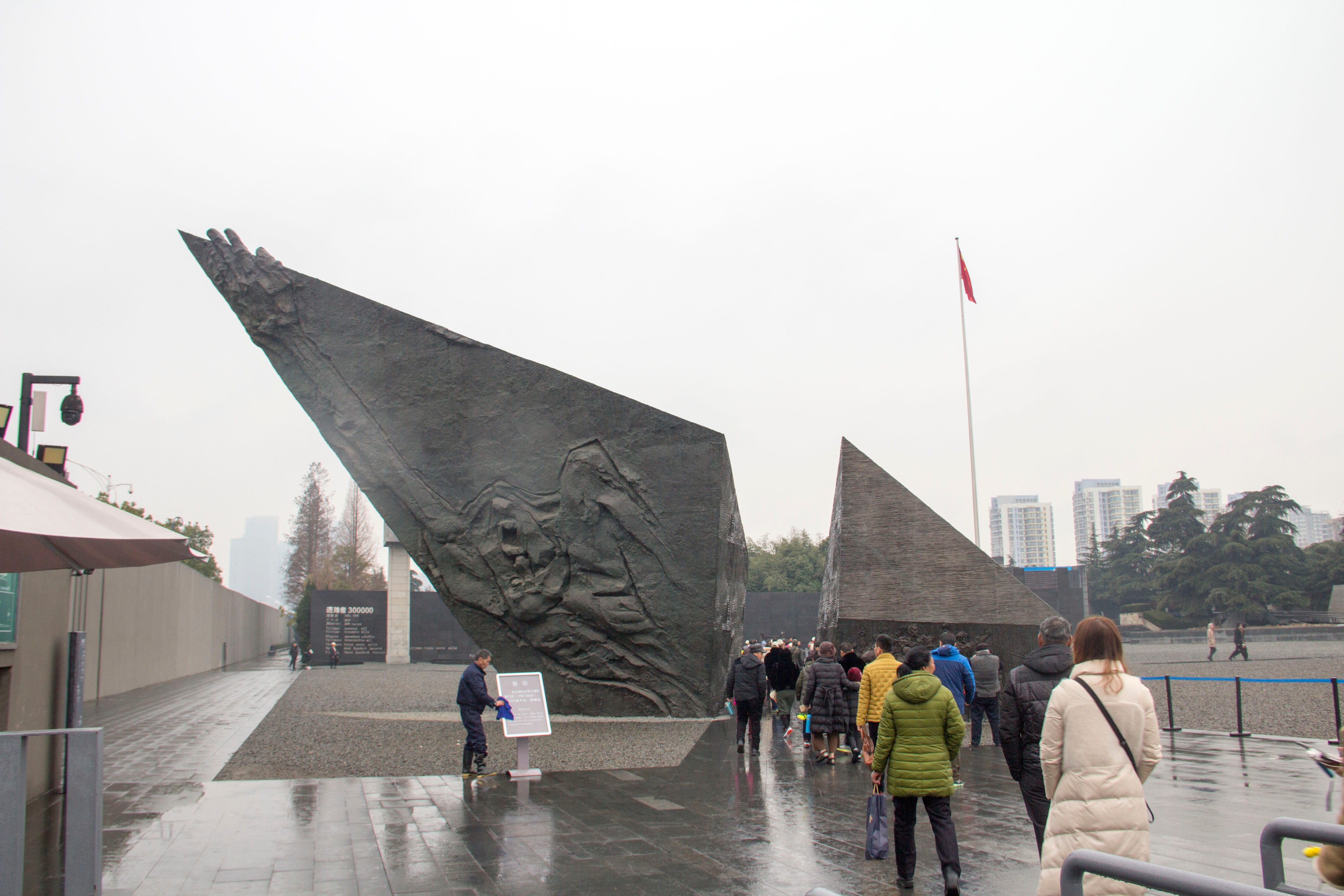
On December 13, 1937, Japanese forces entered the Chinese capital of Nanjing. What followed from mid-December 1937 into early 1938 was one of the most horrific episodes of mass violence in modern history: widespread killing of prisoners of war and civilians, systematic sexual violence against women and girls, and the destruction of the city. The death toll remains disputed—Chinese sources cite 300,000 victims, while Japanese revisionists have challenged whether a “massacre” occurred at all—but the fundamental historical reality of large-scale atrocity is beyond serious scholarly dispute (Askew 2002; Yoshida 2006; Fogel 2000).
Yet the memory of Nanjing was not always central to East Asian politics. For decades after 1945, the massacre occupied a marginal position in Chinese collective memory, overshadowed by the narrative of Communist Party heroism in the war against Japan. It was only in the 1980s—through deliberate state policy, the construction of memorials, and the production of films—that the Nanjing Massacre was elevated to its current status as the defining symbol of Japanese wartime aggression and Chinese victimisation. This transformation raises fundamental questions about how collective memory is constructed, maintained, and mobilised for political purposes.
This chapter examines how one film—Lu Chuan’s 2009 City of Life and Death (Nanjing! Nanjing!)—intervenes in the memory politics of the Nanjing Massacre. The film is remarkable not for what it shows but for how it shows it: rather than presenting the massacre exclusively through Chinese victims’ eyes, Lu Chuan adopts a dual perspective that includes the viewpoint of a conflicted Japanese soldier. This departure from established conventions of Chinese war cinema generated intense domestic controversy and international critical debate. The film thus offers a case study in how cinematic representation shapes collective memory, and how challenges to established memory frameworks can themselves become objects of memory contestation.
The chapter advances three interlocking arguments. First, anti-Japanese sentiment in contemporary East Asia is not a natural response to historical injury but a politically constructed “structure of feeling” that varies significantly across national contexts—a framework developed by Leo Ching that illuminates the institutional and affective dimensions of memory politics (Ching 2019). Second, Lu Chuan’s formal innovation—the dual-perspective narrative—constitutes a challenge to the victim-centred frameworks that have dominated Chinese representations of Japanese wartime violence, a challenge that becomes legible only against the background of zhuxuanlu (main melody) cinema and its patriotic conventions (Kraicer 2010; Yang 2017). Third, the critical controversy surrounding the film—exemplified by the exchange between Shelly Kraicer and Tony Rayns—reveals deeper disagreements about the ethics of identification, empathy, and the meaning of representing atrocity responsibly (Rayns 2010; Zhu 2013).
Part I: The Politics of Memory — From Marginal Event to Central Symbol
The Fall of Nanjing
The military context of the Nanjing Massacre is essential to understanding both the events themselves and their subsequent memorialisation. In the summer of 1937, full-scale war erupted between Japan and China following the Marco Polo Bridge Incident. Japanese forces advanced rapidly, taking Shanghai in November after fierce resistance. Nanjing, the Nationalist capital, lay exposed.
The city’s defence was poorly organised. Generalissimo Chiang Kai-shek withdrew most of the Nationalists’ effective units, leaving the defence to a hastily assembled force of undertrained troops and conscripts under General Tang Shengzhi. When Japanese forces broke through the defensive perimeter on December 12, Tang ordered a retreat—but the order was chaotic, communication collapsed, and many units were trapped within the city walls. The city fell on December 13, 1937 (Yoshida 2006, 23–48).
What followed has been extensively documented by survivors, foreign observers, and, in limited ways, Japanese participants. The violence took multiple forms: the mass execution of prisoners of war and surrendering soldiers, often at the banks of the Yangtze River; the killing of civilians, including targeted attacks on young men suspected of being soldiers in civilian clothes; widespread sexual violence against women and girls; and looting and destruction of property. The killing continued for approximately six weeks, though the most intense violence occurred in the first days after the city’s fall (Fogel 2000, 1–24).
The Politics of Numbers
The death toll has become a site of intense political contestation. The number “300,000” is inscribed prominently at the entrance to the Nanjing Massacre Memorial Hall—a figure that has been repeatedly cited by Chinese authorities and incorporated into textbooks and official commemorations. Yet the evidentiary basis for this figure is contested, and serious historians have offered a wide range of estimates.
David Askew’s careful historiographical analysis distinguishes between “large massacre” (estimates in the hundreds of thousands), “medium massacre” (tens of thousands), and “illusion” (denial) camps, with the latter representing a fringe position that has nonetheless received disproportionate political attention (Askew 2002). The politics of numbers operates on multiple levels: the figure of 300,000 serves as what Pierre Nora might call a lieu de mémoire—a crystallised site of memory that anchors collective remembrance regardless of empirical precision (Nora 1989). Japanese revisionists who challenge the figure are often conflated with outright deniers, even when their estimates still acknowledge large-scale atrocity. The number thus functions less as a historical finding than as a political and moral commitment—a marker of recognition that cannot be negotiated without appearing to diminish the suffering it represents.
The Nanjing Safety Zone
The international dimension of the massacre provides crucial context for its subsequent memorialisation. A small group of foreign nationals who remained in the city established the Nanjing Safety Zone, attempting to shelter civilians amid occupation violence. The Safety Zone Committee was led by John Rabe, a German businessman and Nazi Party member whose diary became one of the most detailed contemporaneous records of the atrocities. Minnie Vautrin, an American missionary educator and administrator at Ginling Women’s College, likewise kept an extensive diary that documents the daily work of protection as negotiation and triage: petitions to Japanese officers, the concealment of women and girls from soldiers, and the moral injuries of witnessing violence that could not be stopped. After returning to the United States in 1940 following a breakdown, Vautrin died by suicide in 1941, a trajectory that has become part of the postwar moral archive through which Nanjing has been narrated to external audiences.1
The documentation produced by these foreign observers proved crucial to postwar legal proceedings and subsequent historical scholarship. But it also shaped the representational framework through which the massacre would be remembered: the Safety Zone foreigners became witnesses whose testimony authenticated Chinese suffering for international audiences. This framework—Chinese victims, Western witnesses, Japanese perpetrators—would structure most subsequent representations of the event.
The Memory Gap: From Marginal Event to Central Symbol
Here we arrive at a paradox that illuminates the constructed nature of collective memory. The Nanjing Massacre, which now occupies the centre of East Asian memory politics, was for decades a marginal event in Chinese collective remembrance. The reasons are complex but illuminating.
In the immediate postwar period, the Nationalist government held war crimes trials in Nanjing and executed several Japanese officers for their role in the massacre. The International Military Tribunal for the Far East (the “Tokyo Trial”) also addressed the Nanjing atrocities, establishing an official death toll and convicting several Japanese commanders. General Matsui Iwane, who commanded the forces that took Nanjing, was executed in 1948. But legal proceedings and historical memory are not the same thing, and the postwar settlement of accounts did not determine how the massacre would be remembered in the decades that followed.
With the Communist victory in 1949 and the Nationalist retreat to Taiwan, the new People’s Republic of China had different priorities. The revolutionary narrative emphasised Communist Party heroism—the Long March, guerrilla warfare, land reform, and the establishment of the New China—rather than Nationalist-era victimisation. The Nanjing government had been a KMT regime; its fall could not easily be incorporated into a story of Communist resistance and triumph. Indeed, emphasising Nanjing might implicitly credit the Nationalists with having fought Japan, when the Communist narrative required that the Party be seen as the primary force of resistance. The massacre was acknowledged but not commemorated; it was a historical fact but not a collective memory.
Moreover, Cold War geopolitics complicated anti-Japanese memory. Japan became a crucial American ally in East Asia after 1945, and both China and Japan had strategic interests in limiting historical grievances. When China sought to normalise relations with Japan in 1972—part of the strategic reorientation following the Nixon visit—both governments agreed to set aside claims for war reparations. Premier Zhou Enlai explicitly stated that the Chinese people should distinguish between the Japanese militarists who had launched the war and the Japanese people who were themselves victims of militarism. This framework—blame the militarists, not the people—served diplomatic purposes but also constrained how the war could be remembered. The Nanjing Massacre was not forgotten, but it could not be mobilised as a basis for anti-Japanese sentiment without contradicting the official line that Sino-Japanese friendship should characterise the new era (Jo 2022).
The transformation came in the 1980s, driven by a convergence of domestic and international factors. Domestically, the Cultural Revolution had discredited the revolutionary narrative that had provided ideological coherence since 1949. The reforms of the Deng Xiaoping era created economic dynamism but also ideological uncertainty: if class struggle was no longer the motor of history, what was China about? Patriotic education offered an answer—Chinese national identity defined not by revolutionary struggle but by historical continuity and shared victimisation at the hands of foreign aggressors.
Internationally, the 1982 textbook controversy provided a catalyst. Japanese Ministry of Education guidelines that year suggested softening language about Japanese wartime actions—changing “aggression” to “advance,” for instance. The controversy was actually more complex than initial press coverage suggested—some of the alleged changes were inaccurately reported—but the perception that Japan was revising history resonated powerfully in China and Korea. The textbook controversy demonstrated that Japanese memory politics remained contested and that vigilance was required to prevent historical revisionism from gaining ground.
The Memorial Hall of the Victims in the Nanjing Massacre by Japanese Invaders opened in 1985 at Jiangdongmen, a massacre and burial site, and its physical and museological design has consistently linked commemoration to claims of evidentiary presence through excavations, exhibits, and the prominent inscription of “300,000” at the entrance. The memorial was part of a broader “patriotic education” campaign that would expand dramatically through the 1990s. The campaign explicitly identified resistance to Japanese aggression—and victimisation by Japanese atrocity—as central to Chinese national identity. Textbooks were revised, museums were built, and commemorative days were established. What had been one atrocity among many—in a war that killed between 15 and 20 million Chinese—became the atrocity: the defining symbol of Japanese aggression and Chinese suffering. The number 300,000 was literally carved in stone at the memorial entrance. December 13 became a day of national mourning in 2014, elevated to the status of a national commemorative day. Films, novels, and television dramas proliferated.
The massacre moved from the margins of collective memory to its centre—not through organic processes of remembrance but through deliberate institutional construction. This is not to say that the memory was “invented” or that the massacre did not happen; it is to observe that what societies remember, and how intensely they remember it, is a product of institutional choices, not a direct reflection of historical experience.
This transformation raises questions that extend well beyond the Chinese case. If memory can be so dramatically revalued—if a marginal event can become central through political will and institutional investment—what does this tell us about the relationship between historical experience and collective remembrance? And what happens when representations challenge the frameworks through which such memory has been constructed?
Part II: Anti-Japanism as Structure of Feeling
Beyond Grievance: Leo Ching’s Framework
To understand why City of Life and Death generated such controversy, we must first understand the cultural and political framework within which representations of Japanese wartime violence operate. Leo Ching’s Anti-Japan: The Politics of Sentiment in Postcolonial East Asia (2019) provides an essential analytical vocabulary.
Ching argues that anti-Japanese sentiment in contemporary East Asia is not simply a natural response to historical injury—the predictable reaction of colonised peoples to their former colonisers. Rather, anti-Japanism is a “structure of feeling”: a constellation of attitudes, affects, and dispositions that is produced and reproduced through specific institutional, political, and cultural practices. This structure of feeling varies significantly across national contexts, shaped by different colonial experiences, postwar trajectories, and contemporary political circumstances (Ching 2019, 1–24).
The concept of “structure of feeling” comes from Raymond Williams, who used it to describe emergent cultural formations that are not yet fully articulated as ideology but are nonetheless socially shared and historically significant. Applied to anti-Japanism, the concept illuminates how sentiment operates: not as an individual emotional response but as a collectively produced disposition, shaped by education, media, commemoration, and political mobilisation. Anti-Japanism is not something people simply feel; it is something they are trained to feel through participation in social institutions and cultural practices.
Constitutive versus Reactive Anti-Japanism
Ching distinguishes between two modes of anti-Japanese sentiment. Reactive anti-Japanism responds to specific Japanese actions, such as textbook revisions, shrine visits, diplomatic statements, or territorial disputes. It flares in response to provocation and subsides when the provocation passes. This is the anti-Japanism of protests, boycotts, and diplomatic crises—episodic and event-driven.
Constitutive anti-Japanism is more fundamental. It is woven into the fabric of national identity itself, such that being Chinese (or Korean, or Taiwanese) involves a particular relationship to Japan and Japanese history. Constitutive anti-Japanism does not require provocation; it is reproduced through education, commemoration, and cultural production regardless of what Japan does or does not do at any given moment. The Nanjing Massacre Memorial Hall, the patriotic education curriculum, and the steady production of anti-Japanese war films—these are institutions of constitutive anti-Japanism, shaping how citizens understand their nation’s past and their own relationship to it (Ching 2019, 25–67).
The distinction matters because it shifts analytical attention from Japanese actions to domestic memory politics. If anti-Japanism is reactive, then reducing friction depends on what Japan does: apologising more sincerely, revising textbooks differently, or refraining from shrine visits. If anti-Japanism is constitutive, then it serves domestic political functions that persist regardless of Japanese behaviour. Understanding which mode predominates—and how they interact—is essential to understanding East Asian memory politics.
Variations: China, South Korea, Taiwan
Ching’s comparative analysis reveals that anti-Japanism takes different forms across East Asia, shaped by distinct colonial and postcolonial histories. The variations are so significant that we might question whether “anti-Japanism” is a single phenomenon at all, or whether we are dealing with distinct structures of feeling that happen to share a common object.
In South Korea, colonialism involved the attempted erasure of Korean identity through forced assimilation: Japanese names, the Japanese language, and the prohibition of Korean cultural practices. The colonial experience was one of systematic cultural violence, and anti-Japanism in Korea remains intensely felt at the popular level. The colonial period is remembered as a time of national humiliation—kukchi—that must be overcome through the assertion of Korean identity and dignity. Anti-Japanese sentiment expresses itself through consumer boycotts, protests at the Japanese embassy, and acute sensitivity to perceived Japanese disrespect. Political leaders who appear too accommodating to Japan risk serious electoral consequences.
The “comfort women” issue has become the focal point of Korean anti-Japanese sentiment. The euphemistic term refers to women—predominantly Korean, but including Chinese, Southeast Asian, and even some Dutch colonial subjects—who were forced into sexual slavery by the Japanese military during the war. The weekly protests that began in 1992 outside the former Japanese embassy site in Seoul have continued for over three decades, organised by the Korean Council for Justice and Remembrance. Statues depicting young Korean women have been erected throughout South Korea and in Korean diaspora communities worldwide, becoming sites of memory that anchor continuing demands for Japanese acknowledgment and apology.
What makes the comfort women issue so intractable is that it combines historical grievance with contemporary gender politics and questions of national sovereignty. Japanese government statements that have been accepted as apologies by some are rejected as inadequate by others. The 2015 agreement between the Park Geun-hye administration and the Abe government, which included a Japanese apology and compensation fund, was subsequently rejected by the Moon Jae-in administration as insufficient and concluded without genuine consultation with survivors. Each cycle of agreement and rejection demonstrates that the issue serves functions beyond historical resolution—it is, in Ching’s terms, constitutive of Korean identity in ways that make “resolution” perpetually elusive (Jo 2022).
In mainland China, the relationship is more complex. Japanese colonialism affected different regions differently: Manchuria was a formal colony from 1931, while other areas experienced occupation during the war years of 1937–1945. The Communist Party’s revolutionary narrative initially competed with victimisation narratives, and anti-Japanism became a significant political force only with the patriotic education campaigns of the 1980s and 1990s. Chinese anti-Japanism is more obviously state-orchestrated than its Korean counterpart, deployed strategically in response to domestic and international circumstances.
This orchestration is visible in the pattern of anti-Japanese protests. Large-scale demonstrations—such as those that occurred in 2005 in response to Japanese textbook revisions and UN Security Council bid, or in 2012 in response to the Senkaku/Diaoyu Islands dispute—appear to be tolerated or even facilitated by authorities, then controlled and contained once they have served their purpose. The capacity to mobilise anti-Japanese sentiment and, equally, to demobilise it suggests a level of state management that would not be possible if the sentiment were purely spontaneous. This does not make Chinese anti-Japanism less real—constitutive anti-Japanism shapes how millions of Chinese citizens understand their history—but it does mean that the Chinese state retains significant capacity to modulate anti-Japanese expression in ways that the Korean state cannot (Ching 2019, 68–112).
Taiwan presents a striking contrast that illuminates the contingency of anti-Japanese sentiment. Despite fifty years of Japanese colonial rule (1895–1945)—longer than either Korea or any part of mainland China—contemporary Taiwan exhibits what Ching calls a “nostalgic Japanophilia” that would be unthinkable in Korea or mainland China. Japanese popular culture circulates freely; colonial-era architecture is preserved, restored, and celebrated as heritage; and surveys consistently show positive attitudes toward Japan among the Taiwanese. Former President Lee Teng-hui, who served from 1988 to 2000, spoke warmly of his Japanese colonial education and maintained that Taiwan and Japan shared a common destiny as democracies facing Chinese authoritarianism.
This does not mean Taiwanese have “forgotten” colonialism—rather, the postwar experience of KMT rule from 1945 created a different relationship to the colonial past. The Nationalist government that took control of Taiwan after Japan’s surrender was widely experienced as alien, corrupt, and brutal. The 228 Incident of 1947—in which KMT forces killed thousands of Taiwanese civilians following an anti-government uprising—and the subsequent decades of martial law under the “White Terror” created a memory framework in which Japanese colonialism could be remembered as comparatively benign. Japanese colonial rule had brought railways, schools, hospitals, and economic development; KMT rule had brought massacre and repression. The comparison may be historically oversimplified, but it structures Taiwanese memory in ways that make anti-Japanese sentiment politically unavailable (Lin 2022).
These variations illuminate the contingency of anti-Japanese sentiment. The same colonial power, producing objectively similar forms of domination—resource extraction, suppression of resistance, cultural imposition—generates radically different memory formations depending on subsequent political development. Memory is not the past itself but a relationship to the past, shaped by present circumstances and political imperatives. Understanding this contingency is essential to understanding why challenges to established memory frameworks—like Lu Chuan’s formal innovations in City of Life and Death—generate such intense reactions.
Anti-Japanism and Film
How does this framework illuminate cinematic representation? Ching’s analysis suggests that films about Japanese wartime violence do not merely reflect existing anti-Japanese sentiment—they help produce and reproduce it. War films are institutions of memory, participating in the construction of the structures of feeling that shape how audiences relate to the past.
This institutional function has implications for what films can and cannot do. A film that operates within the conventions of constitutive anti-Japanism—clear victims, clear perpetrators, clear moral hierarchies—reinforces existing structures of feeling. A film that challenges these conventions—that complicates the victim-perpetrator binary, that invites identification with Japanese characters, that refuses clear moral resolution—risks disrupting the very frameworks through which audiences have been trained to understand the past.
City of Life and Death does precisely this. Understanding why it generated controversy—and what that controversy reveals about memory politics—requires examining the film in detail.
Part III: Dual Perspectives in City of Life and Death
Lu Chuan and Post-Zhuxuanlu Cinema
Lu Chuan came to the Nanjing Massacre with an established reputation as a distinctive voice in Chinese cinema. His previous films—including Kekexili: Mountain Patrol (2004) and The Missing Gun (2002)—demonstrated formal sophistication and willingness to address morally complex material. He was not a director of propaganda films, and his approach to the Nanjing Massacre would reflect this independent sensibility.
The term zhuxuanlu—“main melody”—refers to state-sponsored films that promote official ideology and patriotic values. Zhuxuanlu cinema has dominated Chinese representations of the Anti-Japanese War, establishing conventions that audiences have learned to expect: heroic Chinese resistance, brutal Japanese aggression, clear moral binaries, and narrative resolution that affirms national identity and Communist Party legitimacy. The genre operates within the framework of constitutive anti-Japanism, reinforcing the structures of feeling that shape how Chinese audiences relate to the war (Yang 2017).
Shelly Kraicer’s influential essay identifies City of Life and Death as exemplifying “post-zhuxuanlu” cinema: work that engages with historical material previously dominated by propaganda conventions but does so through art-cinema techniques that challenge rather than reinforce those conventions. Post-zhuxuanlu films “take on the events and subject matter of the main melody war film, but treat them from outside the genre, from the perspective of art cinema, not of propaganda” (Kraicer 2010). The shift is aesthetic but also political: by refusing propaganda conventions, post-zhuxuanlu cinema implicitly questions the frameworks through which the past has been officially remembered.
The Film’s Structure: Two Halves
City of Life and Death is structured around a formal innovation that distinguishes it from virtually all previous Chinese representations of the massacre: the dual-perspective narrative. The film’s first half focuses on the Chinese experience—soldiers, civilians, refugees in the Safety Zone—through techniques familiar from zhuxuanlu cinema. We witness the chaos of the city’s fall, the mass executions of prisoners, and the violence against civilians. The camera aligns us with Chinese suffering.
The second half shifts perspective. The narrative increasingly centres on Kadokawa, a young Japanese soldier who arrives with the occupying forces and witnesses atrocities that gradually destroy his capacity to continue. Kadokawa is not a villain; he is, in the film’s framing, a victim of the war he has been sent to fight. His trajectory culminates in an act of compassion—releasing Chinese prisoners—followed by suicide, unable to reconcile his humanity with the dehumanisation the war demands.
This structural innovation generated the controversy. Lu Chuan had done something unprecedented in Chinese war cinema: he had asked audiences to identify with a Japanese perpetrator, to understand his psychology, to feel something other than hatred when witnessing his suffering. The film does not excuse Japanese actions—the atrocities are depicted with unflinching clarity—but it refuses the dehumanisation of Japanese characters that zhuxuanlu conventions require.
Cinematic Technique and the Ethics of Representation
Lu Chuan’s formal choices reinforce the dual-perspective structure and signal the film’s departure from zhuxuanlu conventions. The most immediately visible is the decision to shoot in black and white—a choice that creates aesthetic distance, signals artistic seriousness, and connects the film to documentary and art-cinema traditions rather than populist war-film conventions. Black-and-white cinematography evokes historical authenticity while simultaneously marking the film as a mediated construction rather than a transparent window onto the past. The visual register is sombre, almost elegiac, refusing the lurid colour that might sensationalise violence.
The cinematography also creates formal unity across the dual perspective. Both Chinese and Japanese characters are rendered in the same monochrome register, their experiences visually equivalent in a way that colour photography might have disrupted. The black-and-white palette suppresses the national flags and military uniforms that would otherwise mark clear visual boundaries between victim and perpetrator. This is not to suggest moral equivalence—the film is unambiguous about who committed atrocities—but rather visual continuity that enables the dual-perspective structure to function.
The film’s treatment of sexual violence exemplifies Lu Chuan’s approach to representing atrocity. The “comfort stations” established by Japanese forces—where women were systematically raped—are depicted, but the camera refuses voyeuristic positioning. We see the faces of women being processed into the stations; we see Japanese soldiers waiting in queues; we see the aftermath and psychological devastation. But the film does not reproduce sexual violence for spectatorial pleasure. The camera maintains distance at moments when exploitation cinema would move closer. This restraint marks a significant departure from conventions that use sexual violence as spectacle while claiming to condemn it.
The character of Jiang Shuyun, played by Gao Yuanyuan, embodies the film’s moral complexity. A teacher who initially helps deceive Japanese authorities about the presence of soldiers among the refugees in the Safety Zone, she ultimately volunteers herself for the comfort stations to protect other women. The scene in which she makes this decision is extraordinarily restrained—there is no melodramatic speech, no tearful farewell, merely a quiet determination that the audience must interpret. Her sacrifice is not triumphalist; there is no suggestion that it will save the others, or that her death is redemptive in any conventional sense. The film offers martyrdom without consolation, suffering without meaning.
The Japanese soldier Kadokawa is introduced as part of the occupying force, initially indistinguishable from his fellow soldiers. His gradual individualisation—as a character with interiority, doubt, moral struggle—structures the film’s second half. Unlike the Japanese soldiers in zhuxuanlu cinema, who are typically depicted as uniformly brutal, Kadokawa is shown experiencing horror at what he witnesses and participates in. His growing psychological disintegration is depicted through increasingly fragmented visual language: close-ups of his face registering incomprehension, dissociated point-of-view shots, and the gradual withdrawal from engagement with his unit.
Kadokawa’s trajectory raises difficult questions about the film’s moral economy. On one hand, his characterisation demonstrates that Japanese soldiers were human beings capable of conscience—a corrective to dehumanising representations that render atrocity incomprehensible. The film implicitly argues that understanding how ordinary people commit extraordinary violence is essential to preventing future atrocity; depicting perpetrators as subhuman monsters obscures the institutional and psychological mechanisms that enable atrocity to occur. On the other hand, screen time devoted to Kadokawa’s psychological suffering is screen time not devoted to Chinese victims. The balance of attention—how much we see through his eyes, how much his interiority is developed—becomes itself a site of ethical contestation.
When Kadokawa releases Chinese prisoners in the film’s climax, the act is not heroic in any conventional sense. It is the collapse of a man who can no longer sustain the violence his position requires—an act of refusal rather than resistance. His subsequent suicide completes the arc: unable to continue as a soldier, unable to return to civilian life, unable to live with what he has done and witnessed. The ending refuses to resolve either the Japanese or the Chinese characters the film has followed. There is no liberation, no justice, no suggestion that meaning can be extracted from what has occurred.
The film’s handling of John Rabe—the German businessman who led the Safety Zone Committee—adds another dimension. Rabe is depicted sympathetically, as a man who did what he could in impossible circumstances. But the film does not centre him as Western-produced Nanjing narratives sometimes do. He is a supporting character, not a saviour figure. This choice reflects Lu Chuan’s decision to tell the story through Chinese and Japanese perspectives rather than the familiar Western-witness framework that has characterised much Nanjing representation.
Part IV: The Ethics of Identification
The Domestic Controversy
City of Life and Death was commercially successful in mainland China, but it generated significant controversy, especially around the film’s allocation of interiority and empathy to a Japanese soldier. Online responses were polarised, with many viewers objecting to the sympathetic treatment of Kadokawa. Some critics accused Lu Chuan of diminishing Chinese suffering by giving screen time to a Japanese perspective. Others charged that the film served Japanese revisionist interests, regardless of the director’s intentions.
The controversy illuminates the stakes of challenging established memory frameworks. Lu Chuan’s formal innovation was not merely aesthetic; it disrupted the structures of feeling through which audiences had been trained to relate to this history. A film that invites identification with Japanese characters—that asks viewers to feel sympathy for a perpetrator’s psychological suffering—violates the emotional logic of constitutive anti-Japanism. The viewer is placed in an uncomfortable position: to respond to the film’s emotional cues is to betray the frameworks that define proper Chinese relationships to this past.
This dynamic helps explain why the controversy took the form it did. Objections were not primarily about historical accuracy—the film’s depiction of atrocities is well-documented. They were about identification: who deserves our emotional investment, whose suffering is permitted to move us, and what feelings are legitimate when confronting this history. The controversy was, in other words, a struggle over the structures of feeling themselves.
The Kraicer-Rayns Debate
The critical controversy found concentrated expression in an exchange between Shelly Kraicer and Tony Rayns in the pages of Cinemascope magazine. Their disagreement is worth examining in detail because it clarifies what is at stake in representing atrocity cinematically—questions that extend well beyond this particular film to fundamental issues in the ethics of representation.
Kraicer’s reading is largely sympathetic. He identifies City of Life and Death as an achievement of post-zhuxuanlu cinema, praising Lu Chuan’s “courage” in departing from propaganda conventions and engaging with morally complex material through art-cinema techniques. For Kraicer, the dual-perspective structure represents a genuine aesthetic and ethical innovation: by refusing to dehumanise Japanese characters, the film opens space for more sophisticated reflection on war and memory than zhuxuanlu cinema permits. Kadokawa’s humanity does not excuse Japanese atrocities; it illuminates the psychological and institutional mechanisms through which ordinary people become perpetrators. Understanding these mechanisms, Kraicer suggests, is essential to preventing future atrocities. Films that depict perpetrators as inhuman monsters may satisfy emotional needs for clear moral condemnation, but they obscure the very processes we need to understand (Kraicer 2010).
Kraicer situates Lu Chuan within a broader transformation in Chinese cinema’s engagement with difficult historical material. The emergence of post-zhuxuanlu filmmaking reflects both the loosening of propaganda conventions and the increasing sophistication of Chinese audiences, who can recognise and reject crude patriotic manipulation. Lu Chuan’s film respects its audience by refusing easy answers—a respect that zhuxuanlu cinema, with its predetermined moral schemas, cannot offer. For Kraicer, this is progress: Chinese cinema is developing the capacity to engage with its own history through artistic rather than merely propagandistic frameworks.
Rayns objects sharply. In his “Letter to the Editor,” he challenges Kraicer’s framing on several grounds. Most fundamentally, he questions whether Lu Chuan has actually departed from Chinese cinema conventions as significantly as Kraicer claims. Rayns points to earlier Chinese films that depicted Japanese characters with some complexity; Kraicer's innovation may be less novel than it appears. More pointedly, he asks whether the focus on Kadokawa’s psychology displaces attention from Chinese suffering—whether the film’s formal structure, regardless of the director’s intentions, reproduces a hierarchy in which Japanese interiority becomes more cinematically interesting than Chinese death.
This is a serious charge, and it touches on fundamental questions about the ethics of attention in representing atrocity. There is a sense in which any representation of mass violence faces an impossible choice: the sheer scale of death resists individualisation, yet individualisation is how cinema typically creates emotional engagement. City of Life and Death resolves this tension by individualising both Chinese and Japanese characters, but the dual-perspective structure means that the individualisation of the Japanese experience necessarily competes with that of the Chinese for screen time and audience attention. Rayns suggests that this competition may not be neutral: that the formal conventions of psychological drama may work better for the perpetrator’s crisis of conscience than for the victim’s experience of violence (Rayns 2010).
The debate also raises questions about cultural ownership of historical memory. Who has the right to tell this story, and how? Kraicer, writing for an international film journal, celebrates the film’s departure from Chinese propaganda conventions. But from another perspective, those “propaganda conventions” represent the Chinese collective memory of a Chinese trauma. A film that challenges those conventions to appeal to international art-cinema audiences might be seen as subordinating Chinese memory needs to cosmopolitan aesthetic values. The tension is not easily resolved: there are good arguments for challenging nationalist memory frameworks, and good arguments for respecting communities’ right to remember their traumas as they see fit.
Yanhong Zhu’s scholarly analysis attempts to navigate this tension. She argues that Lu Chuan’s innovation lies precisely in making Japanese perpetrators psychologically complex without exonerating them—that Kadokawa’s tragedy illuminates rather than obscures the mechanisms of atrocity. The film “refuses to align itself with the ideological position of either nation,” instead offering a “humanist” perspective that transcends national frameworks (Zhu 2013). Kadokawa’s suicide is not redemption; it is the logical terminus of a system that destroys the humanity of perpetrators as well as victims. By depicting this destruction, the film offers a more comprehensive critique of war than films that simply condemn Japanese soldiers as monsters.
But Zhu’s “humanist” reading raises its own questions. Can there be a position “above” national memory frameworks when those frameworks structure how audiences actually receive films? The Chinese viewers who objected to the film’s treatment of Kadokawa were not confused about its intentions—they understood that Lu Chuan was attempting something different from zhuxuanlu cinema. Their objection was precisely to that difference: they did not want a humanist perspective that equalised attention across victim and perpetrator. Whether that objection is ultimately defensible—whether memory communities have the right to reject representations that challenge their established frameworks—remains contested.
The Perpetrator’s Gaze and the Problem of Identification
The controversy over City of Life and Death connects to a broader discourse in trauma studies and Holocaust representation about what has been called “the perpetrator’s gaze”—the ethical problems that arise when representations invite audiences to see atrocity through perpetrators’ eyes.
The problem can be stated simply: empathy tends to follow perspective. When we see events through a character’s eyes, share their point of view, and follow their psychological development, we tend to identify with them—to feel what they feel, to understand (if not endorse) their choices. This is how narrative cinema works. But when the character whose perspective we share is a perpetrator of atrocity, identification becomes ethically fraught. Do we want audiences to identify with someone who participates in mass killing? What does such identification do to our moral understanding of the events depicted?
Defenders of perpetrator perspective argue that understanding is not endorsement. Depicting a perpetrator’s psychological journey—the mechanisms by which an ordinary person becomes capable of extraordinary violence—serves important purposes. It demystifies atrocity, showing that mass violence is committed by human beings rather than monsters. It illuminates the institutional and ideological structures that enable violence. And it reminds us that under different circumstances, we too might be capable of terrible things—a recognition that can encourage vigilance against the conditions that produce atrocity.
Critics respond that this theoretical defence does not adequately account for how audiences actually experience films. The emotional logic of cinema—the way perspective and identification work—may produce effects that exceed or contradict the filmmaker’s intentions. A viewer who spends an hour following Kadokawa’s psychological disintegration may emerge with sympathy for his suffering that competes with, rather than supplements, recognition of Chinese victimisation. The film may intend one thing and accomplish another.
There is also a concern about representational justice. Victims of mass atrocity are, by definition, unable to represent themselves—they are dead. The dead have no perspective that can be cinematically rendered; their suffering can only be depicted from outside, through others’ eyes. Perpetrators, by contrast, can be given rich interiority, psychological development, and moral struggle. The asymmetry is inherent to the form: cinema does interiority well, and the dead have no interiority to represent. Does the perpetrator-perspective film, however well-intentioned, reproduce this asymmetry in ways that are ultimately disrespectful to victims?
City of Life and Death navigates these concerns through its dual-perspective structure and refusal of redemptive resolution. Kadokawa does not learn from his experiences, become a better person, or atone. His story does not build toward a moment of moral clarity that would allow audiences to feel good about having identified with him. The suicide that ends his arc is not cathartic—it is, if anything, an indictment of the system that produced him. But whether this formal strategy successfully addresses the perpetrator-gaze problem, or merely reframes it, remains a matter of debate.
Nationalism, Globalism, and the Market
The controversy surrounding City of Life and Death cannot be fully understood without attention to the film’s production and distribution context. Lu Chuan explicitly sought international audiences; the dual-perspective structure can be read as both a commercial and an artistic strategy, making the film legible to viewers outside the Chinese memory framework. The black-and-white cinematography, art-cinema pacing, and psychological complexity mark the film as festival-ready, aimed at audiences who would reject zhuxuanlu conventions as propagandistic.
This positioning generates its own tensions. A film designed for international circulation may not serve the same memory functions as one made for domestic audiences alone. The very qualities that make City of Life and Death appealing to Western festival programmers—formal sophistication, moral ambiguity, refusal of propaganda conventions—may be the qualities that domestic audiences experience as betrayal of proper Chinese relationship to this history.
Jing Yang’s analysis situates the film within broader transformations in Chinese cinema’s engagement with the global market. As Chinese films seek international audiences and recognition, they increasingly adopt aesthetic strategies legible to global art-cinema audiences. But this adaptation may compromise the films’ capacity to serve domestic memory functions. The tension between national memory and global circulation—between constitutive anti-Japanism and cosmopolitan art-cinema values—structures the reception of City of Life and Death and many other contemporary Chinese films that address sensitive historical material (Yang 2017).
There is also a question about who benefits from challenging nationalist memory frameworks. Lu Chuan’s formal innovations may serve progressive purposes—complicating simplistic patriotism, humanising the enemy, and encouraging reflection rather than reaction. But they may also serve market purposes that have little to do with ethics or politics. International art-cinema audiences reward certain kinds of formal innovation; films that challenge national conventions may do so not from principled cosmopolitanism but from commercial calculation. The critique of nationalism can itself become a marketable commodity.
This is not to impugn Lu Chuan’s intentions—by all accounts, he approached the material with genuine seriousness and commitment. But it is important to observe that individual intentions do not determine how cultural products circulate and function. A film exists in a market context that shapes its meaning regardless of what its maker intended. Understanding the controversy over City of Life and Death requires attention to this context, not just to the film’s formal properties or its director’s vision.
The global circulation of memory—through film, digital media, tourism, and transnational activist networks—raises questions that extend well beyond any single case. How do memory communities maintain coherence when their memories circulate globally? What happens when representations challenge established frameworks that reach audiences those frameworks were designed to include? These questions will only become more pressing as national memories continue to be produced, circulated, and contested in a globalising world.
Conclusion: The Past That Is Not Past
City of Life and Death offers a case study in the politics of memory and the ethics of representation. Lu Chuan’s formal innovation—the dual-perspective narrative that includes the viewpoint of a conflicted Japanese soldier—challenged the conventions through which Chinese audiences had been trained to relate to the Nanjing Massacre. The controversy that followed illuminated not just disagreements about one film but deeper questions about how societies remember atrocity and what representations of violence are for.
Four conclusions emerge from this analysis.
First, collective memory is institutionally constructed, not naturally emergent. The Nanjing Massacre’s transformation from marginal event to central symbol of Japanese wartime aggression demonstrates that memory does not simply reflect historical experience—it is produced through deliberate political, educational, and cultural practice. The structures of feeling through which Chinese citizens relate to this history are shaped by patriotic education campaigns, memorial construction, and decades of cultural production. The number 300,000 carved in stone at the memorial entrance is not a historical finding but a political commitment, a marker of recognition that cannot be negotiated without appearing to diminish the suffering it represents. Understanding memory politics requires attention to these institutional mechanisms, not just to the events being remembered.
Second, anti-Japanese sentiment in East Asia operates as what Leo Ching calls a “structure of feeling”—a collectively produced disposition that varies across national contexts and serves domestic political functions that persist regardless of Japanese behaviour. The distinction between reactive and constitutive anti-Japanism illuminates why memory disputes prove so intractable: constitutive anti-Japanism is woven into national identity itself, not merely a response to Japanese provocation that can be resolved through appropriate Japanese action. The striking contrast between Korean anti-Japanism, Chinese anti-Japanism, and Taiwanese Japanophilia—despite comparable colonial experiences—demonstrates that memory is a relationship to the past, not the past itself. Understanding this structure is essential to understanding why films like City of Life and Death generate controversy—they challenge not just historical interpretations but the very frameworks through which audiences have been trained to feel.
Third, representing atrocity involves irreducible ethical tensions that cannot be resolved through formal innovation alone. Humanising perpetrators may serve important purposes—understanding how ordinary people commit extraordinary violence is crucial to preventing future atrocities. But humanisation also distributes attention and emotional investment, potentially displacing focus from victims to perpetrators. The asymmetry between perpetrator interiority (which can be represented) and victim experience (which often cannot, because victims are dead) creates representational problems that may be endemic to the form. The Kraicer-Rayns debate exemplifies these tensions without resolving them. There may be no representation of atrocity that fully satisfies all legitimate ethical demands; the question is what trade-offs specific representations make and whether those trade-offs serve the purposes that memory should serve.
Fourth, the global circulation of memory creates new challenges and opportunities that memory communities are still learning to navigate. Films made for international audiences may challenge nationalist frameworks in ways that domestic audiences experience as betrayal. Cosmopolitan art-cinema values may conflict with community memory needs. The market rewards certain kinds of formal innovation, which means that challenges to nationalism can become commodities regardless of their originators’ intentions. Understanding these dynamics requires attention to production and circulation contexts, not just to texts and their formal properties.
Lu Chuan’s film remains controversial precisely because it refuses easy resolution. It depicts atrocity without sensationalism, humanises perpetrators without exoneration, and challenges national memory frameworks while remaining legible to domestic audiences. Whether these achievements represent ethical innovation or problematic compromise depends on what we believe representations of atrocity are for—and that question, like the memory of Nanjing itself, remains contested.
The controversy also illuminates a relationship between history and memory that extends beyond this particular case. History, in the professional sense, aspires to understand the past as it was, through critical engagement with evidence and argument. Memory, in the collective sense, serves present needs—for identity, solidarity, recognition, justice. These are not the same thing, and representations of the past inevitably negotiate between them. City of Life and Death is not a history; it is a film that operates through the conventions of narrative cinema to create emotional engagement and moral reflection. But it is a film about history, drawing on historical events to argue for how the past should be remembered. The controversy it generated demonstrates that such claims are never innocent—that every representation of the past is an intervention in ongoing struggles over what the past means and who has the right to say so.
The past, as William Faulkner observed, is not dead; it is not even past. The Nanjing Massacre occurred in December 1937, but its memory is actively constructed and contested in the present. Films like City of Life and Death do not merely reflect existing memory—they participate in its ongoing production, shaping how new generations will understand and feel about events they never witnessed. Every formal choice—what to show, what to omit, whose perspective to adopt, how to frame violence, whether to offer resolution—is also a choice about how the past will be remembered.
The stakes are not merely academic. How East Asian societies remember the war shapes how they relate to each other in the present. The persistence of memory disputes—over textbooks, shrine visits, territorial claims, apologies—demonstrates that the past continues to structure contemporary politics in ways that cannot be wished away. Understanding how memory works—how it is constructed, challenged, and defended—is essential to understanding the politics of East Asia today and the possibilities for its future. City of Life and Death is one intervention in this ongoing process, a film that both reflects and contests the memory politics of its time. Its controversy is not merely a dispute about one director’s artistic choices; it is a window onto the larger struggles over history and memory that continue to shape East Asian politics and society.
References
Askew, David. 2002. “The Nanjing Incident: Recent Research and Trends.” Electronic Journal of Contemporary Japanese Studies 2 (1).
Ching, Leo T. S. 2019. Anti-Japan: The Politics of Sentiment in Postcolonial East Asia. Durham: Duke University Press.
Fogel, Joshua A., ed. 2000. The Nanjing Massacre in History and Historiography. Berkeley: University of California Press.
Jo, Eun A. 2022. “Memory, Institutions, and the Domestic Politics of South Korean–Japanese Relations.” International Organization 76 (4): 767–798.
Kraicer, Shelly. 2010. “A Matter of Life and Death: Lu Chuan and Post-Zhuxuanlu Cinema.” Cinemascope 41 (January–March).
Lin, Jie. 2022. “Nostalgia for Japanese Colonialism: Historical Memory and Postcolonialism in Contemporary Taiwan.” History Compass 20 (11): e12751.
Nora, Pierre. 1989. “Between Memory and History: Les Lieux de Mémoire.” Representations 26: 7–24.
Rayns, Tony. 2010. “Letter to the Editor.” Cinemascope 42 (12 March).
Yang, Jing. 2017. “Reconstructing the Patriotic Discourse in Contemporary Chinese Cinema: City of Life and Death and Cow.” The Journal of Popular Culture 50 (4): 685–703.
Yoshida, Takashi. 2006. The Making of the “Rape of Nanking”: History and Memory in Japan, China, and the United States. Oxford: Oxford University Press.
Zhu, Yanhong. 2013. “A Past Revisited: Re-presentation of the Nanjing Massacre in City of Life and Death.” Journal of Chinese Cinemas 7 (2): 85–108.
On Vautrin’s biography and death, see “Minnie Vautrin,” Wikipedia, last modified [use your access date], https://en.wikipedia.org/wiki/Minnie_Vautrin. On the Ginling materials and diary holdings, see Disciples of Christ Historical Society, “Minnie Vautrin papers,” https://discipleshistory.as.atlas-sys.com/repositories/2/archival_objects/14418