

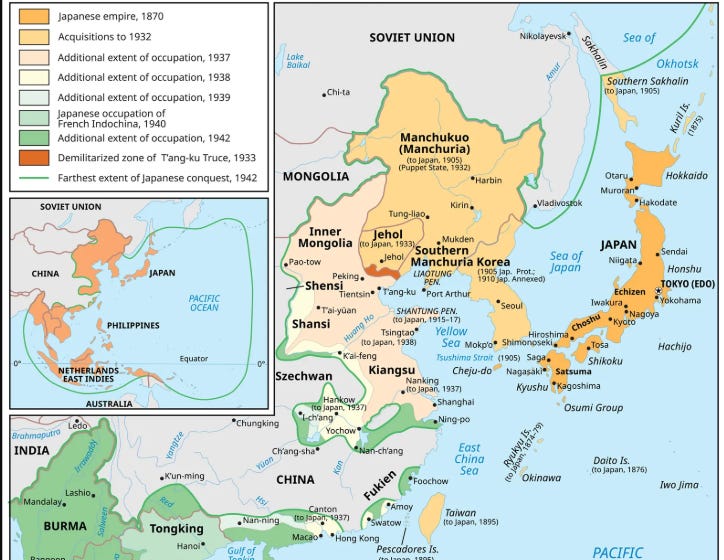
The global order Japan encountered in the 1850s operated through a grammar of civilization that determined which polities counted as sovereign and which could be legitimately subjected. Japanese leaders learned this grammar remarkably quickly. They then applied it—first to justify their own claims to recognition, then to justify their subjection of others. The logic was consistent even as the position reversed. The same categories that had threatened Japan with colonization became categories Japan deployed to colonize others. The same techniques that Western powers used to make Asian territories governable were refined and extended by Japan. The student became practitioner—and eventually victim of the system he had mastered, as the logic of imperial expansion generated the catastrophe of the Pacific War.
The Grammar of Civilization
The international order that confronted Japan in the mid-nineteenth century was not a neutral framework of rules but a classification system that sorted polities into categories with radically different entitlements. At its core was a distinction between “civilized” states possessing full sovereignty and other entities—variously labeled barbarous, savage, or simply uncivilized—whose sovereignty was partial, conditional, or nonexistent (Tago 2025, 39). The system emerged from European arrangements following the Peace of Westphalia in 1648, but by the nineteenth century, it had acquired global reach and, ostensibly, universal application.
What made a polity “civilized”? The criteria were never formally codified, but the operational markers were clear enough: territorial boundaries defined and defended, centralized administration capable of enforcing laws and honoring treaties, legal systems recognizing property rights and commercial contracts, standing military forces under state control, and diplomatic apparatus capable of conducting relations with other recognized states. European powers had developed these institutional forms through centuries of competitive state-building. Non-European polities were now measured against standards that encoded specifically European historical experience as universal requirements for political legitimacy.
The shift from natural law to legal positivism during the nineteenth century reinforced these distinctions. Earlier international law had recognized some constraints on European behavior toward non-European peoples, grounded in universal theories of natural rights. Positivist jurisprudence abandoned such constraints: law was what states agreed to, and only civilized states could participate in the agreement. Non-civilized peoples existed outside the system of mutual obligations that bound civilized states to each other. They could be dealt with by whatever means civilized powers found convenient.
The practical consequences of classification were substantial. Civilized states enjoyed full sovereignty—the right to conduct foreign relations, control internal affairs without external interference, and have treaties honored by other states. They could not be legitimately conquered or colonized. By contrast, so-called uncivilized peoples possessed no such protections. Their territories could be claimed under doctrines like terra nullius—the legal fiction that lands not governed by recognized political authority belonged to no one and could be appropriated by whoever arrived first (Tago 2025, 42). Their populations could be subjected to rule by civilized powers under various justifications: commercial necessity, religious mission, the “civilizing” burden itself.
The Berlin Conference of 1884–85 demonstrated how the system operated at scale. European powers gathered to partition Africa according to principles they themselves defined. African polities were not consulted; their preferences were irrelevant because they had not been recognized as possessing the sovereignty that would entitle them to participation. The conference established “effective occupation” as the criterion for colonial claims—a requirement that privileged European organizational forms while dismissing indigenous governance as insufficiently effective to count. Africa was carved into colonies whose boundaries reflected European negotiations rather than African realities.
Between full sovereignty and outright colonization lay intermediate arrangements. The unequal treaty system imposed on China, Japan, Siam, and other Asian polities after the Opium Wars exemplified this middle ground. These treaties granted Western powers extraterritoriality—exemption of their nationals from local jurisdiction—along with fixed tariffs that deprived Asian governments of customs autonomy, most-favored-nation clauses that prevented discriminatory treatment, and rights to station troops and gunboats in treaty ports. The treaties were not agreements between equals; they formalized hierarchy while preserving nominal sovereignty.
The logic was self-reinforcing. Asian legal systems were deemed inadequate to protect Western nationals; therefore, Western nationals required extraterritoriality. But extraterritoriality prevented Asian governments from exercising full jurisdiction; therefore, the Asian legal systems remained inadequate. The treaties created the conditions they purported to address, ensuring that subordinate status would persist until Asian governments reformed themselves according to Western specifications—and Western powers decided the reforms were sufficient.
The system operated through recognition. A polity became civilized not by meeting objective criteria but by being acknowledged as civilized by those already in the club. Recognition was political, granted or withheld according to the interests of existing members. Western powers could recognize a state’s sovereignty when convenient and deny it when inconvenient, invoking civilizational standards flexibly to justify whatever outcome they preferred. The grammar of civilization thus provided vocabulary for domination that sounded like a neutral assessment.
This was the order Japan confronted when Commodore Perry’s squadron entered Edo Bay in 1853. The Americans had not come seeking diplomatic relations with a sovereign equal; they had come to compel a backward nation to open itself to commerce. Perry’s letters spoke of friendship and trade, but his warships spoke louder. The treaties Japan signed over the following years replicated the unequal arrangements imposed on China: extraterritoriality, fixed tariffs, and foreign settlements. Japan was classified as uncivilized—not quite barbarous enough to colonize outright, but insufficiently developed to merit equal treatment. The classification was both diagnosis and sentence: Japan was uncivilized, therefore Japan would be treated unequally, therefore Japan must transform itself to escape the classification.
Learning the Rules
The Meiji transformation that followed can be understood as an intensive program of institutional learning. Japanese leaders grasped that the international order operated through categorical distinctions and that Japan’s survival depended on moving between categories. The goal was not modernization in some abstract sense but reclassification—producing the institutional markers that would compel Western recognition of Japanese sovereignty.
This required studying the specifications. The Meiji government dispatched missions to observe Western institutions firsthand: the Iwakura Embassy of 1871–73 spent nearly two years examining governmental, educational, military, and industrial systems across the United States and Europe. The mission’s members were not tourists but surveyors, compiling detailed reports on how Western states organized themselves. They returned with blueprints—and with a clearer understanding of what recognition would require.
The reforms that followed were systematic and comprehensive. The military organization adopted the German model—conscription replacing the samurai monopoly on violence, staff planning replacing individual prowess, and hierarchical command replacing personal loyalty. Educational curricula followed French patterns, establishing schools that would produce the literate, numerate population that modern administration required. The navy copied British standards, creating the force that would eventually defeat Russia at Tsushima. Legal codes drew on French and German precedents, establishing the property rights, contract law, and commercial regulations that Western powers demanded as prerequisites for equal treatment.
Constitutional government on the Prussian model created parliamentary structures while preserving imperial authority. The Meiji Constitution of 1889 established a bicameral legislature, cabinet government, and formal rights—institutions that satisfied Western expectations for civilized governance. Yet actual power concentrated in bodies insulated from electoral accountability: the Privy Council, the genrō (elder statesmen who had led the restoration), the military. The form was European; the substance was crafted to serve Japanese purposes. Japanese leaders had learned not just what institutions to create but how to make institutions serve strategic ends.
The strategy worked, but slowly. Western powers remained reluctant to reclassify Japan despite institutional reforms. Treaty revision—eliminating the unequal provisions that marked Japan as uncivilized—took decades of negotiation. British agreement to end extraterritoriality came only in 1894; full tariff autonomy was not restored until 1911. The lesson was clear: institutional transformation alone was insufficient. Recognition required a demonstration of power.
The Sino-Japanese War of 1894–95 provided that demonstration. The immediate cause was competition for influence in Korea, but the war’s significance extended far beyond the Korean peninsula. Japan’s decisive victory over China—the power that had dominated East Asian international relations for centuries—announced that the regional hierarchy had shifted fundamentally. The Treaty of Shimonoseki forced China to cede Taiwan, pay massive indemnities, and recognize Korean independence from Chinese suzerainty. Japan had defeated the central power of the traditional Asian order and extracted concessions similar to those Western powers extracted from Asian states.
More importantly, Japan had conducted a civilized war: a formal declaration, a professional officer corps operating according to modern doctrine, and the treatment of prisoners meeting Western standards of the time. The war was exhibition as much as conquest—demonstration that Japan possessed the military capability and institutional discipline that civilization required. Western observers, who had expected a Chinese victory, reassessed Japanese capabilities.
The Triple Intervention that followed demonstrated the limits of military victory. Russia, France, and Germany compelled Japan to return the Liaodong Peninsula, invoking concerns about regional stability. The intervention was transparently self-interested: Russia wanted the peninsula for its own warm-water port ambitions. Yet Japan could not resist three European great powers simultaneously. The prize won on the battlefield was stripped away at the conference table. Japan had played by Western rules and won, only to have Western powers change the rules.
The intervention taught that military victory was necessary but insufficient; Japan needed diplomatic alliances and sufficient power to deter great-power interference. Japanese leaders drew appropriate conclusions. Military budgets expanded; naval construction accelerated; diplomatic efforts intensified. The goal was a capability sufficient to prevent a repeat of the Triple Intervention.
The Anglo-Japanese Alliance of 1902 marked a new level. Britain, seeking a counterweight to Russian expansion in East Asia, found in Japan a partner whose interests aligned with its own and whose institutional development met British standards. The alliance was recognition in the fullest sense: Japan was now civilized enough to ally with the world’s preeminent power on formally equal terms. The alliance also provided a security guarantee; Britain would not join combinations against Japan as it had in the Triple Intervention.
The Russo-Japanese War of 1904–05 confirmed the new status. Japan defeated a European great power—the first Asian nation to do so in modern times. The victory resonated across Asia and the colonized world: the racial hierarchy that European supremacy seemed to establish was not immutable. Colored people could defeat white people. The implications were revolutionary, even if Japan’s own racial hierarchies precluded their implementation.
The Treaty of Portsmouth, mediated by President Theodore Roosevelt, gave Japan control over Korea and predominant interests in southern Manchuria. Japan had arrived as an imperial power, recognized by the great powers and capable of enforcing its interests in East Asia. The transformation from target of Western pressure to imperial actor had taken half a century—rapid by historical standards, glacial by the pace Japanese leaders preferred.
The annexation of Korea in 1910 completed the trajectory. Japan had established a protectorate in 1905, stripping Korea of diplomatic autonomy while preserving nominal sovereignty. Over the following years, Japanese control deepened: advisors in government ministries, Japanese police replacing Korean forces, and Japanese capital penetrating the economy. The annexation formalized what had already occurred, absorbing Korea entirely into the Japanese empire. Itō Hirobumi, the architect of the protectorate, had favored gradual absorption rather than outright annexation—a preference that did not save him from An Junggeun’s bullets.
The justifications for annexation deployed the vocabulary Japan had learned from the West. Korea was characterized as backward, incapable of self-governance, and in need of guidance from a more advanced civilization. The language echoed European justifications for colonialism precisely because it was modeled on them. Japan claimed not conquest but uplift, not exploitation but development, not domination but guidance. The categories used to classify Japan as uncivilized now served to classify Korea for subjugation. The student had become the teacher—and was applying the lessons with rigorous consistency.
Producing Colonial Subjects
Having learned how civilized powers recognized each other, Japanese administrators turned to learning how civilized powers governed those they classified as uncivilized. The colonial apparatus developed in Taiwan after 1895 and Korea after 1910 was not improvised but studied—modeled on techniques Japanese observers had documented in European colonies and adapted to local circumstances.
The foundational problem was legibility. Colonial administration required knowing what existed in the territory: who lived there, what they owned, how they were organized, what they produced, and how they moved. Without such knowledge, extraction was inefficient, and control was incomplete. The first task of the colonial government was thus to produce information that had not previously existed in usable form—transforming complex social arrangements into standardized categories that administrators could manipulate.
Cadastral surveys exemplified this process. In Korea, the colonial administration conducted comprehensive land surveys from 1910 to 1918, mapping every parcel and registering ownership. The stated purpose was modernizing property relations—replacing customary arrangements with clear titles that would facilitate commerce and taxation. The actual effect was transforming land into a governable category. Land that could not be documented according to survey specifications—communal lands, lands with unclear customary tenure, lands whose cultivators could not produce acceptable proof of ownership—became available for appropriation. The surveys did not merely record existing property relations; they reorganized them according to administrative categories that advantaged Japanese settlers and the colonial state (Gilliland 1920, 54).
The Oriental Development Company operationalized this reorganization. Established in 1908, the company channeled Japanese agricultural settlement into Korea, acquiring land through mechanisms enabled by cadastral surveys. Korean farmers who could not document ownership in accordance with new requirements lost their claims; those who retained title often found themselves unable to access credit except through institutions that extracted favorable terms. The company was not merely a commercial enterprise but an instrument of population management—relocating Japanese settlers, converting Korean owners into tenants, restructuring the agrarian economy to serve metropolitan needs. By the 1930s, the polarization of Korean agriculture was stark: Japanese settlers occupied landlord positions while Korean farmers worked as tenants on land their families had cultivated for generations.
Similar techniques operated in Taiwan. Gotō Shinpei, the capable administrator who governed the colony from 1898 to 1906, emphasized what he called “scientific colonialism”—systematic data collection, public health measures, infrastructure development, and graduated assimilation. The approach produced genuine improvements in some indicators: transportation networks expanded, disease mortality declined, agricultural productivity increased, and life expectancy rose. But the improvements served colonial purposes. Infrastructure connected extraction points to ports. Public health preserved labor power. Agricultural development oriented production toward Japanese markets—particularly sugar, which Taiwan exported in quantities that made the colony significant to the metropolitan economy. Taiwan became, in one analyst’s phrase, “an agricultural appendage of Japan” (Ho 1978, 29).
The racial hierarchy was fundamental to the colonial apparatus’s operation. Japanese occupied administrative positions; Taiwanese and Koreans occupied subordinate roles regardless of education or capability. Nearly ninety percent of financial capital remained under Japanese control. Taiwanese participation in colonial bureaucracy was negligible at upper levels. The system did not merely extract resources; it organized social relations according to categories that positioned the Japanese as inherently superior—categories that administrative practice reinforced daily.
The knowledge-production apparatus extended beyond economic administration. Colonial education systems aimed to produce particular kinds of subjects: literate enough to function in the colonial economy, Japanese-speaking enough to receive instructions, loyal enough to accept subordination. The curriculum taught Japanese language, Japanese history, and Japanese values—the civilization that colonial subjects were expected to absorb. Korean language instruction was progressively restricted; by the wartime period, policies forced colonial subjects to adopt Japanese names (sōshi-kaimei). The goal was not the elimination of Korean or Taiwanese identity but its administrative irrelevance—creating populations who would function as Japanese subjects regardless of ancestry.
The colonial apparatus thus operated on two registers simultaneously. Economically, it extracted resources and redirected production toward metropolitan benefit. Administratively, it produced new categories of person and property that rendered colonial populations visible and manageable. The two functions reinforced each other: economic extraction required administrative knowledge, and administrative categorization facilitated economic extraction. The machinery was comprehensive, sophisticated, and self-reinforcing.
Resistance was itself categorized. Colonial police forces developed classification systems for anti-Japanese activity: bandits, rebels, thought criminals, each category warranting different responses. The March First Movement of 1919, when Koreans mounted mass protests demanding independence, was suppressed with considerable violence—but it also generated an administrative response. The subsequent “cultural policy” relaxed some restrictions while intensifying surveillance and co-optation. Korean-language newspapers were permitted under censorship; Korean cultural organizations were tolerated under police monitoring. The colonial state learned from resistance, adapting its techniques while maintaining its fundamental extractive purpose. The system was not static but responsive—a learning organization that incorporated feedback while preserving its essential structure.
The gendered dimensions of colonial administration deserve particular attention. Women occupied specific positions within the colonial apparatus—as objects of population management, as laborers in particular sectors, as targets of assimilation policies, and ultimately as victims of the wartime “comfort women” system. This system of sexual slavery, which expanded dramatically during the 1930s and wartime period, demonstrated how colonial categories enabled atrocity. The women—predominantly Korean, but also Chinese, Filipino, Indonesian, and others—were categorized administratively as “comfort women,” a euphemism that obscured the systematic coercion involved. Recruitment operated through networks the colonial apparatus had created: labor contractors who had mobilized workers for other purposes, police who could compel compliance, and local officials who identified vulnerable populations. The system did not emerge from nowhere; it was built on the administrative infrastructure developed for other colonial purposes, repurposing the knowledge produced by surveys and registrations.
The Limits of Recognition
The Paris Peace Conference of 1919 revealed what Japanese leaders had suspected but perhaps not fully accepted: the grammar of civilization contained racial limits that no amount of institutional development could transcend. Japan arrived at Versailles as a victor—one of the “Big Five” powers that would reshape the postwar order. Japanese delegates expected recognition commensurate with Japan’s contribution and institutional achievement.
The racial equality clause exposed the limits. Japanese delegates proposed including in the League of Nations Covenant a provision affirming the equality of all races—modest language that would have committed signatories to nothing specific while acknowledging a principle Japan considered fundamental. The proposal was blocked. Australian and American delegations, representing societies committed to excluding Asian immigrants, could not accept even a symbolic affirmation of racial equality. When the proposal secured majority support but failed to achieve the unanimity that Woodrow Wilson suddenly deemed necessary, the message was unmistakable (Kawamura 1997, 503–526).
The rejection clarified what “civilization” had always meant. Japan had met every institutional criterion Western powers had specified. Japan had demonstrated military capability, established a constitutional government, developed an industrial economy, and conducted diplomacy in accordance with accepted norms. Japan had, in short, produced all the documentation civilization required. Yet recognition remained partial because the classification system was ultimately racial. Asian people could be civilized but never quite equal.
Woodrow Wilson’s role illuminated the contradictions. Wilson had articulated principles—self-determination, open diplomacy, collective security—that seemed to promise transformation of the international order. His rhetoric resonated across the colonized world; delegations from Korea, China, Vietnam, and elsewhere converged on Paris, hoping the American president would support their aspirations. The rhetoric proved hollow.
Wilson could not deliver on his principles because doing so would have threatened the interests of powers whose support he needed for the League of Nations. Genuine self-determination would have threatened French and British colonial possessions. Racial equality would have contradicted American immigration law and domestic racial arrangements. Wilson needed Japan’s support for the League; he also needed Britain and France, whose domestic populations would not accept racial equality. Faced with impossible contradictions, Wilson sacrificed principle to expediency (Manela 2007).
The Shandong decision made the point concretely. China requested the return of Shandong province, which Japan had seized from Germany during the war. Wilson, needing Japanese support for the League, accepted Japanese claims despite having promised otherwise. Chinese delegates refused to sign the treaty; the May Fourth Movement erupted in protest at home. Self-determination applied to European peoples but not to Asian ones. The principle was universal in rhetoric and particular in application.
Ho Chi Minh traveled to Paris, hoping to present Vietnamese grievances to Wilson, but was unable to secure a meeting. The Korean delegation that arrived seeking support for independence was similarly ignored. The colonized world had taken Wilson seriously; Wilson had not meant what he said. The disillusionment was profound and generated radicalization that would shape the century.
Japanese responses to the Versailles outcome diverged. Some concluded that continued cooperation with Western powers remained Japan’s best strategy—that patient engagement would eventually overcome racial barriers. Shidehara Kijūrō, who would dominate Japanese foreign policy through the 1920s, pursued this cooperative approach: working within the Washington treaty system, avoiding actions that would alarm Western powers, and trusting that economic interdependence would better serve Japanese interests than military expansion. The approach had logic; Japan was industrializing rapidly, and trade with the West fueled growth.
Others drew different conclusions. If the international order would never accept Japan as an equal regardless of institutional achievement, then Japan should pursue its interests through power rather than recognition. The racial exclusion laws that the United States enacted in 1924—explicitly barring Japanese immigration on racial grounds—reinforced this view. The laws were not merely discriminatory; they were humiliating, explicitly categorizing Japanese as unfit for American society regardless of individual qualities. The exclusion intensified sentiment that the West would never accept Japan and that Japan must therefore create its own order.
Pan-Asianist ideologies gained traction: Japan should lead Asia against Western imperialism, creating a regional order in which Japan would occupy the position Western powers denied it in the global order. The ideology contained obvious tensions—Japan’s own colonial behavior belied claims to Asian solidarity—but it provided a framework for understanding Japan’s situation and rationale for expansion.
The Washington Conference of 1921–22 institutionalized an uneasy compromise. The Five-Power Treaty limited capital ship construction according to ratios that acknowledged Japanese regional predominance while preserving American and British global superiority: 5:5:3 for the United States, Britain, and Japan, respectively. The Nine-Power Treaty affirmed the Open Door in China, foreclosing the spheres of influence that Japan had been constructing. The arrangements preserved peace but satisfied no one. Japanese nationalists resented the inferior naval ratio as confirmation of racial hierarchy; Chinese nationalists resented continued great-power intervention; American navalists resented constraints on building programs.
The cooperative framework held through the 1920s. But it rested on assumptions—that economic growth would continue, that moderate political forces would retain power, that the constraints were temporary accommodations rather than permanent subordination—that the Great Depression would shatter.
The Earthquake and the Exposure
The Great Kanto Earthquake of September 1923 exposed what the formal structures of Japanese society concealed. Within hours of the earthquake, rumors spread that Koreans were poisoning wells, setting fires, and committing other acts of sabotage. Vigilante groups organized. Police forces—rather than suppressing the rumors—actively spread them, in some cases providing lists of Korean residences. Over the following days, mobs murdered thousands of Koreans along with smaller numbers of Chinese and Japanese mistaken for Koreans. The death toll remains disputed; estimates range from several thousand to over six thousand (Ryang 2003, 737).
The massacre revealed the violence underlying Japan’s claims to have transcended its own “uncivilized” past. Japan had demanded racial equality at the Paris Peace Conference, arguing that Japanese civilization was equal to Western civilization. Yet the Korean minority within Japan—colonial subjects who had migrated to the metropole seeking economic opportunity—were slaughtered on the basis of racial hatred that mobilized instantly when social order broke down. The contrast between Japan’s diplomatic claims and domestic reality was stark.
The massacre also revealed how colonial categories had penetrated metropolitan society. Koreans in Japan occupied a distinctive position: formally Japanese subjects after annexation, but legally and socially subordinate, concentrated in manual labor, residentially segregated, and subject to police surveillance. The colonial apparatus designed to govern Korea had produced categories that also functioned in Japan. Koreans were visible as a distinct population—knowable, locatable, targetable—because administrative systems had made them so. When catastrophe shattered normal constraints, those categories provided the framework for violence.
The rumors themselves were significant. Koreans were accused of precisely the kinds of acts—poisoning water supplies, setting fires, committing sabotage—that would have been rational responses to colonial oppression. The accusations projected onto Koreans the resistance that Japanese authorities feared. The rumors were false, but they expressed real anxieties about what colonial subjects might do if given the opportunity. The earthquake temporarily disrupted the surveillance and control systems that kept colonial subjects subordinate; the rumors imagined what might happen if that disruption became permanent.
The response of Japanese authorities was revealing. The military deployed to restore order, but in ways that facilitated rather than prevented violence against Koreans. Some military units participated in killings; others stood aside while vigilantes operated. The police, who had spread the initial rumors, made arrests only belatedly and selectively. Investigations were perfunctory; prosecutions were minimal; official acknowledgment was evasive.
The Japanese government could not confront what the massacre revealed about the nature of its colonial project without undermining the legitimacy claims on which that project rested. Japan claimed to be bringing civilization to Korea; the massacre demonstrated that Japanese civilization included the capacity for racial pogrom. Japan claimed that Koreans were Japanese subjects entitled to protection; the massacre demonstrated that Korean lives were expendable when Japanese anxieties required scapegoats. The violence was therefore administratively managed: attributed to confusion and rumor rather than systematic racial hatred, deplored in general terms, while particular perpetrators escaped accountability. The categories that had enabled the massacre remained intact; only the overt violence was suppressed.
The earthquake also triggered debates about reconstruction that revealed deeper tensions in Japanese society. The physical destruction was immense—over 100,000 dead, Tokyo and Yokohama devastated—and reconstruction required choices about what kind of society Japan would become. Intellectuals proposed various programs: rejecting Western materialism, strengthening traditional morality, imposing comprehensive urban planning, and building a more egalitarian society. The debates exposed fissures between modernizers and traditionalists, liberals and authoritarians, internationalists and nationalists.
The Ministry of Education responded by emphasizing moral restoration. Textbooks published after the earthquake exalted family values, loyalty to the emperor, sacrifice, and dedication to national advancement. The “cultivation of national morality” became an explicit educational policy. The response to physical destruction was ideological reconstruction—not addressing the conditions that had produced the massacre but reinforcing the values that had made it possible. The emperor system, the racial hierarchy, and the subordination of the individual to national purpose: these were presented as foundations for recovery rather than as sources of the crisis (Borland 2006, 875–907).
The Kanto Earthquake thus marked a turning point less because of what it destroyed than because of what it revealed. Japan’s engagement with the international order had operated through claims about civilizational achievement: Japan deserved recognition because Japan had developed the institutions civilization required. The massacre demonstrated that institutional development coexisted with racial violence indistinguishable from what European powers practiced in their colonies, or indeed worse, since the violence was directed against formal subjects of the Japanese state. Japan had indeed learned from the West, including lessons about how to treat subject populations that the grammar of civilization was supposed to have transcended.
The international context reinforced domestic tensions. The Washington Conference had established a framework that constrained Japanese expansion while preserving Western advantages. Cooperative diplomacy meant accepting limits that nationalists found humiliating. The Immigration Act of 1924, which explicitly excluded Japanese, arrived while memories of the earthquake were fresh. The juxtaposition was striking: Japan was expected to accept an inferior status in international arrangements while confronting domestic evidence that its claims to civilization were contradicted by its treatment of colonial subjects. The tensions would intensify through the decade until the Great Depression shattered the economic foundations on which cooperative diplomacy rested.
Empire Consuming Itself
The 1930s brought the logic of imperial expansion to its conclusion. The Manchurian Incident of 1931—manufactured by Japanese army officers to justify the seizure of Manchuria—violated the treaty frameworks Japan had accepted at Washington. The League of Nations condemned Japan’s actions; Japan withdrew from the League in 1933. The choice was explicit: empire over international legitimacy.
Manchukuo, the puppet state that Japan established in Manchuria, embodied the contradictions of Japanese imperialism. Nominally independent under the last Qing emperor, Puyi, the state was in practice controlled by Japanese administrators and defended by Japanese troops. The arrangement preserved the vocabulary of sovereignty while evacuating its substance—precisely what Western powers had done to Japan through the unequal treaties, now reproduced by Japan toward others. Japanese planners envisioned Manchukuo as a laboratory for economic development free from the constraints of metropolitan politics: heavy industry, strategic resources, coordinated planning. The reality was extraction for military purposes, exploitation of Chinese labor, and administration that served Japanese interests while claiming to benefit local populations.
The militarization of Japanese politics represented a fundamental transformation. The Meiji architects had intended civilian control over military force, maintained through informal coordination among elder statesmen who had led the restoration. By the 1930s, those elder statesmen had died, and no comparable institution existed to coordinate civil-military relations. Structural vulnerabilities in the Meiji Constitution—military direct access to the emperor, General Staff independence from cabinet control, requirement that army and navy ministers be serving officers—became mechanisms through which military factions dominated policy.
The young officer movement added revolutionary violence to institutional dysfunction. Junior officers motivated by anti-capitalism, agrarian romanticism, and emperor-centered nationalism mounted coup attempts that reshaped the political landscape, even when they failed in their immediate objectives. The May 15 Incident of 1932, when young naval officers assassinated Prime Minister Inukai Tsuyoshi, ended the era of party government. Their trial became a platform for nationalist propaganda; lenient sentences signaled that political violence from the right would be tolerated. The message was clear: those who killed in the emperor’s name would not face serious consequences.
The February 26 Incident of 1936—more extensive uprising seeking to establish direct imperial rule—was suppressed after the emperor himself ordered restoration of order. Yet the aftermath strengthened military factions seeking expansion through institutional channels rather than coups. By the late 1930s, Japan had become what contemporaries called the “national defense state”: political, economic, and social institutions progressively subordinated to military requirements. The National Mobilization Law of 1938 gave sweeping powers to direct resources toward war production. Political parties dissolved into the Imperial Rule Assistance Association. The media became instruments of state propaganda. The civilian sphere contracted as military imperatives expanded.
Full-scale war with China from 1937 produced consequences that shaped everything that followed. The Nanjing Massacre—weeks of murder, rape, and destruction following the capture of China’s capital—shocked international opinion and demonstrated what Japanese military culture could produce when restraints dissolved. Estimates of those killed range from tens of thousands to over two hundred thousand. The atrocity was not an aberration but an expression of attitudes cultivated through military training: contempt for the Chinese, brutalization of conscripts, and absence of accountability for violence against civilians.
The war in China also demonstrated the limits of military victory without political resolution. Japanese forces could defeat Chinese armies in conventional battles, but could not pacify the territories they occupied. Guerrilla resistance persisted; collaboration was unreliable; the resources required for occupation exceeded what the war was supposed to provide. Each expansion created new vulnerabilities requiring further expansion to secure—the classic imperial trap that had ensnared European powers and would now ensnare Japan.
The ideological intensification accompanying military expansion made compromise progressively impossible. The concept of the “national body” (kokutai), centering on the emperor as the living embodiment of the Japanese nation, provided the foundation for unlimited sacrifice. Wartime slogans invoked a willingness to fight to the last Japanese rather than accept defeat. The ideology was not merely propaganda but a belief system that shaped how leaders understood their options. Retreat or compromise became not just strategically undesirable but spiritually impossible—betrayal of the national essence.
The decision to go to war with the United States and Britain in December 1941 represented a desperate gamble by leaders who saw no alternative but to accept American-imposed economic sanctions or fight to break free. The oil embargo imposed in response to Japanese expansion into Indochina threatened to immobilize the Japanese military within months. American demands—withdrawal from China, abandonment of the Tripartite Pact with Germany and Italy—would have required reversing a decade of expansion. Rather than accept constraints on imperial ambitions, Japan’s leaders chose war they knew they were unlikely to win. The gamble was that rapid conquests would create facts on the ground that exhausted Western powers would eventually accept.
The initial phase brought spectacular successes. Pearl Harbor, the fall of Singapore—where a smaller Japanese force captured the supposedly impregnable fortress along with over 80,000 Allied prisoners—the conquest of the Dutch East Indies, the sweep through Southeast Asia: within six months, Japan controlled an empire extending from the Central Pacific to the borders of India. The conquests demonstrated Japanese military capability at its peak while exposing tens of millions to Japanese occupation.
Occupation policies varied but shared common features. Resource extraction for the war effort produced food shortages and famine. The romusha system mobilized millions of Southeast Asians for forced labor, with mortality rates that constituted a mass atrocity. Treatment of prisoners of war violated international conventions systematically; of approximately 140,000 Western military prisoners, more than 35,000 died in captivity—a death rate of roughly 25 percent, compared to less than 4 percent for Western prisoners held by Germany. The “comfort women” system subjected tens of thousands of women, predominantly Korean, to sexual slavery for military use.
The tide turned at Midway in June 1942. The island-hopping campaign across the Pacific brought American forces steadily closer while submarine warfare devastated Japanese shipping. By 1944, the empire’s sea lanes were severed; territories Japan had conquered became isolated garrisons awaiting destruction. Firebombing of Japanese cities, beginning in earnest in 1945, killed hundreds of thousands and destroyed urban infrastructure. The March 1945 Tokyo raid alone killed an estimated 100,000 people.
Okinawa, the Pacific War’s bloodiest battle, demonstrated what home islands invasion would entail: over 100,000 Japanese military dead, roughly 100,000 Okinawan civilian casualties—many induced to suicide by propaganda warning of American atrocities—and more than 12,000 American dead. Kamikaze attacks characterized the final phase, young men volunteering to die for a cause that rational calculation would have recognized as lost.
The atomic bombs at Hiroshima and Nagasaki, combined with the Soviet declaration of war and invasion of Manchuria, finally compelled surrender. The emperor’s broadcast announcing capitulation—the first time most Japanese had heard his voice—marked an era’s end. Japan’s empire collapsed with military defeat: Korea was divided between American and Soviet occupation zones, Taiwan returned to Chinese control, and Manchuria was stripped of industrial equipment by Soviet forces. The colonial apparatus was dismantled, but the categories it had produced—territorial claims, administrative boundaries, frameworks for understanding what had occurred—persisted into the arrangements that followed.
What Remains Unresolved
The history of Japanese imperialism persists in the present not as memory alone but as institutional residue. Territorial disputes, compensation claims, and contests over historical interpretation all derive from the categorical work empire performed—work that defeat disrupted but did not undo.
The Dokdo/Takeshima dispute exemplifies the persistence of imperial categories. Japan claims the islands partly on the basis of Shimane Prefecture’s 1905 incorporation—an administrative act conducted as Japan was tightening control over Korea prior to annexation. Korea claims the islands based on earlier documentation, including Imperial Ordinance No. 41 of 1900, which incorporated Ulleungdo and its associated islands into the Korean administrative structure. The San Francisco Peace Treaty of 1951, which was supposed to settle territorial questions, did not specifically mention the islands, leaving both parties to construct arguments from its ambiguous silence (Jo 2021, 98–113; Jo 2023, 209–234; Choi 2005, 467).
The dispute’s intractability derives not from the islands’ intrinsic value—they are small, remote, and economically marginal except for surrounding fishing waters—but from what they represent. For Korea, accepting Japanese claims to Dokdo would mean accepting that the 1905 incorporation was legitimate—that the administrative acts of the colonial period retain legal force. Accepting Japanese sovereignty would mean accepting that colonialism produced valid property rights, that categories created to facilitate domination remain binding after domination ends. For Japan, abandoning claims to Takeshima would mean acknowledging that the entire apparatus of colonial administration operated illegitimately—a concession with implications extending far beyond two small islands. The dispute is thus about the status of colonial categories as such, which is why diplomatic resolution has proved impossible despite the disproportion between the territory at stake and the intensity of the controversy.
The Senkaku/Diaoyu dispute operates through similar dynamics. Japan incorporated the islands in 1895, the same year it acquired Taiwan. China and Taiwan claim the islands on historical grounds and argue that Japan’s incorporation was part of the same imperial expansion that seized Taiwan. The San Francisco Peace Treaty’s treatment of the islands was ambiguous; American administration of Okinawa, which included the Senkaku Islands, further complicated matters. The reversion of Okinawa to Japan in 1972 transferred American-administered territory without resolving underlying sovereignty claims. As with Dokdo, the dispute concerns not just the islands but the legitimacy of acts performed during the imperial period.
The “comfort women” issue demonstrates how categorization shapes what acknowledgment means. The system—organized sexual slavery for Japanese military use—is documented beyond serious dispute. What remains contested is how to characterize it and, therefore, what response is appropriate. Japanese government positions have shifted over decades, from denial to acknowledgment to partial retraction to renewed acknowledgment. The 1993 Kono Statement acknowledged military involvement and coercion; subsequent administrations have questioned its basis. The 2015 agreement between Japan and South Korea, which included an apology and a compensation fund, was rejected by many survivors and their advocates as inadequate.
The persistence of controversy reflects categorical stakes. If the women were volunteers or prostitutes, Japanese responsibility is limited to the regulation of an unsavory but hardly unique wartime phenomenon. If they were victims of systematic coercion organized by the state, Japanese responsibility extends to recognition of state crime and appropriate redress. If coercion was primarily carried out by private recruiters rather than by military personnel, responsibility diffuses. Each categorization implies different conclusions about what Japan owes and to whom. The disputes are not about facts in isolation—the facts are largely established—but about the frameworks within which facts acquire meaning and generate obligations.
Historical textbooks occasion periodic crises because they institutionalize particular categorical frameworks for transmission to new generations. Japanese textbooks that describe colonialism in terms of modernization and development—emphasizing infrastructure construction, educational expansion, and economic growth—categorize the colonial period as fundamentally beneficial and thus not requiring apology. Korean and Chinese textbooks emphasizing exploitation, violence, and cultural destruction categorize the same period as fundamentally criminal. The textbook disputes are not about whether particular events occurred but about how to characterize the period overall and therefore what lessons to draw.
The Yasukuni Shrine crystallizes these tensions. The shrine honors Japan’s war dead, including fourteen Class A war criminals enshrined in 1978. When Japanese prime ministers visit, they are—from one perspective—honoring sacrifice in service of the nation, an act comparable to any nation honoring its military dead. From another perspective, they are honoring the architects of aggressive war and colonial atrocity, signaling that Japan does not accept international categorization of its wartime leadership as criminal. The shrine visits occasion diplomatic protests because the categorical stakes are substantial: whether Japan accepts or rejects the framework through which the postwar order understood the war.
Constitutional constraints on Japanese military capability reflect assumptions about the persistence of imperial potential. Article 9, imposed during American occupation but subsequently embraced by significant portions of the Japanese public, renounces war and war potential. The provision embodies determination that Japan would never again embark on military conquest—an acknowledgment that imperial logic, once institutionalized, proved difficult to control. Debates over constitutional revision, the scope of Japan’s Self-Defense Forces, and Japan’s role in collective security all take place in the shadow of what the empire produced.
The transformation of the international order since 1945 has eliminated some conditions that drove Japanese imperialism while leaving others in place. Formal colonialism has ended; sovereign states’ juridical equality is generally acknowledged; nuclear weapons have made great-power war potentially suicidal; international institutions provide mechanisms for managing disputes. Yet competition among states persists, resources remain unequally distributed, and the categorical hierarchies that enabled imperialism have mutated rather than disappeared. Development discourse echoes civilizational discourse; humanitarian intervention echoes the civilizing mission; structural adjustment echoes the unequal treaties.
The history of Japanese imperialism thus offers not lessons to be extracted but patterns to be recognized. Japan’s trajectory from victim of imperialism to imperial power demonstrates how states can transform themselves in the face of existential threats—and how the logic of transformation can produce catastrophe. The institutional apparatus that enabled Japan’s rise generated dynamics that civilian leadership could not control, commitments that foreclosed compromise, and categories that outlasted the empire they organized. Understanding this trajectory requires attention not to intentions but to mechanisms: how institutions produce the knowledge that makes certain actions possible, how categories create the subjects they purport to describe, how administrative techniques generate consequences their designers did not anticipate.
What remains unresolved in East Asian international relations is not simply disagreement about the past but disagreement about the categories through which the past becomes intelligible. Until those categories are themselves subjected to scrutiny—until the question shifts from “what happened” to “how was this made knowable”—the institutional residue of empire will continue to shape what reconciliation can mean.
Conclusion
Japan’s imperial century traced one of history’s most dramatic arcs: from a nation forced open at gunpoint to an empire spanning the Western Pacific, from imperial zenith to total defeat within three years. The speed of transformation in both directions reflected the particular dynamics of the late nineteenth- and early twentieth-century international order—an order that distributed sovereignty along civilizational lines and rewarded those who mastered its grammar while punishing those who miscalculated its constraints.
Japanese leaders learned the grammar of empire with remarkable speed. They understood that survival required reclassification, that reclassification required producing institutional markers recognized by Western powers, and that recognition required demonstrating power. The Meiji transformation was thus instrumental modernization—not imitation from admiration but production of documentation. The strategy succeeded: Japan achieved recognition as a civilized power, escaped colonization, and joined the ranks of imperial states.
Having learned how civilized powers recognized each other, Japanese administrators learned how civilized powers governed those they classified as uncivilized. The colonial apparatus developed in Taiwan and Korea drew on techniques observed in European colonies, adapted to local circumstances, and refined through experience. Cadastral surveys made land into governable property. Education systems produced administrable subjects. Police classifications rendered resistance manageable. The machinery was sophisticated, comprehensive, and ultimately self-destructive.
The limits of recognition—exposed at Paris in 1919, reinforced by American exclusion laws, never fully transcended—generated responses that led toward catastrophe. If the international order would never accept Japan as an equal, regardless of institutional achievements, then some concluded that Japan should pursue its interests through power rather than recognition. Pan-Asianism offered an ideological framework; military expansion offered a practical means. The logic of empire, once embraced, proved difficult to limit. Each expansion created vulnerabilities requiring further expansion; each atrocity required ideological intensification to justify; each commitment foreclosed the compromises that might have limited disaster.
What remains is not merely memory but institutional residue. The categories the empire produced—territorial claims, administrative boundaries, frameworks for understanding what occurred—persist in disputes that defeat did not resolve. Dokdo, the comfort women, Yasukuni, and textbook content: each controversy derives from the categorical work the empire performed. The disputes are intractable, not because the facts are unknowable but because the frameworks for interpreting facts remain contested. Different categorizations produce different conclusions about what acknowledgment, apology, and reconciliation would require.
The history of Japanese imperialism thus matters not as a cautionary tale but as an analytical resource. It illuminates how international orders distribute sovereignty according to classifications that appear neutral but encode particular interests; how states learn to produce the institutional markers that recognition requires; how colonial administration operates through knowledge-production that makes populations visible and governable; how the logic of imperial expansion generates dynamics that exceed the intentions of those who set it in motion; and how the categories empire produces outlast the institutional structures that created them. These patterns are not unique to Japan. They characterize imperialism as such. Japan’s trajectory is particularly clear because the transformation was so rapid, the documentation so extensive, and the consequences so catastrophic.
The question for the present is whether the categorical frameworks inherited from imperialism can be subjected to the scrutiny they require—whether the analysis can shift from what happened to how this was made knowable, from what Japan did to how institutional mechanisms produced outcomes that no one fully controlled. Such an analysis would not resolve the disputes the empire generated. But it might clarify what resolution would require: not agreement on the past but transformation of the categories through which the past becomes intelligible in the present.
References
Borland, Janet. 2006. “Capitalising on Catastrophe: Reinvigorating the Japanese State with Moral Values Through Education Following the 1923 Great Kanto Earthquake.” Modern Asian Studies 40 (4): 875–907.
Choi, Sung-jae. 2005. “The Politics of the Dokdo Issue.” Journal of East Asian Studies 5 (3): 465–494.
Gilliland, Clarence. 1920. “Japan and Korea Since 1910.” Annual Publication of the Historical Society of Southern California 11 (3): 47–57.
Ho, Samuel. 1978. Economic Development of Taiwan, 1860–1970. New Haven: Yale University Press.
Jo, Kyu-hyun. 2021. “The Shadow of Cold War Politics Over Territorial Sovereignty: The San Francisco Peace Treaty and Its Implications for Japan’s Territorial Disputes with Korea and China.” The Journal of Territorial and Maritime Studies 8 (2): 98–113.
Jo, Kyu-hyun. 2023. “The Elevation of Ulleungdo from an Island to a Province and the Korean Government’s Expression of Governmentality as Territorial Nationalism.” The Review of Korean Studies 26 (1): 209–234.
Kawamura, Noriko. 1997. “Wilsonian Idealism and Japanese Claims at the Paris Peace Conference.” Pacific Historical Review 66 (4): 503–526.
Manela, Erez. 2007. The Wilsonian Moment: Self-Determination and the Origins of Anti-Colonial Nationalism. Oxford: Oxford University Press.
Ryang, Sonia. 2003. “The Great Kanto Earthquake and the Massacre of Koreans in 1923: Notes on Japan’s Modern National Sovereignty.” Anthropological Quarterly 76 (4): 731–748.
Tago, Atsushi. 2025. Introduction to International Relations. Singapore: Springer Nature.